
A tale so crazy, it’s gotta be true. Whisky believed to have been distilled nearly two centuries ago, and sipped by a young Queen Victoria, was found behind a hidden cellar door in a 750-year-old castle in Scotland.
Officials believe this is the oldest known Scotch whisky in existence, and it will soon be offered for sale at auction.
According to Perth, Scotland-based Whisky Auctioneer, industry leading buyer and seller of whisky and spirits, 24 bottles of the whisky will go up for auction in November.
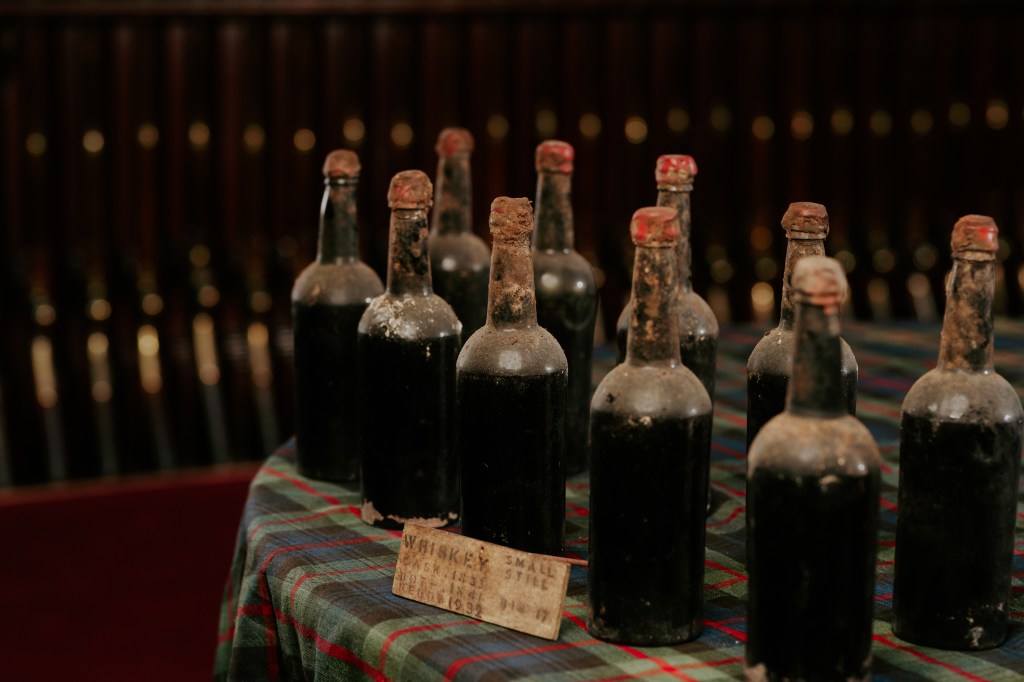
It was in late 2022 when Bertie Troughton, resident trustee at Blair Castle in Perthshire, found a number of old bottles in an unassuming cellar room. Around 40 of those bottles were whisky, discovered at the back of a shelf.
They are believed to have been distilled in 1833 and bottled in 1841 (the whisky was then rebottled in 1932).
A statement from Whiskey Auctioneer notes that Blair Castle maintains close connections with Clan Murray members, particularly through the Murray Clan Society of North America.
And the connections continue as the U.S. remains the largest export destination by value, reaching $1.3 billion in 2022, up 33% from 2021, marking the first time Scotch exports have exceeded a billion dollars in the U.S. according to the SWA 2023.
The bottles’ history continues, as Queen Victoria had strong connections to Blair Castle and a close friendship with the 6th Duchess of Atholl. In 1844, Queen Victoria and her consort, Prince Albert, visited and during her three-week stay, the Blair Castle Household Book reveals that whisky was consumed during her visit.
Local newspapers at the time reported Queen Victoria’s liking for ‘Atholl Brose,’ a local drink of whisky with honey. It’s highly likely that the bottles being auctioned are the same whisky that was consumed by Queen Victoria and Prince Albert during her stay.
The bottles were initially sampled by the family and a local whisky expert before Whisky Auctioneer was contacted. Since then, research in the archives of Blair Castle and Atholl Estates, alongside authentication of the whisky by the Scottish Universities Environmental Research Centre via carbon dating supports its early 19th century origin.
Joe Wilson, head curator and spirits specialist at Whisky Auctioneer, said, “Offering the world’s oldest scotch whisky at auction is truly a once in a lifetime occurrence. I’m fortunate to be well acquainted with old and rare liquid, as Whisky Auctioneer handles some of the world’s rarest whisky bottlings. This, however, is a transcendent discovery that is sure to capture not just the imagination of the whisky industry but also those well beyond.”
He continued, “Distilled in the 1830s, the whisky was made during a fascinating period when whisky production was experiencing massive change following the 1823 Excise Act, making it a particularly exciting find for those interested in the history and heritage of the Scotch whisky industry.”
Extensive references to the production of whisky and aqua vitae throughout history, specifically the early 19th century, were found in documents held in the Blair Castle archive.
Bertie Troughton, of Blair Castle, said they are fortunate to have one of the best archives of any historic house in Scotland, “And it’s been wonderful to see the story of these fabulous bottles come to life in the archives. Whisky has always been a huge part of the history of Blair Castle and we will be building an exhibition around the bottles we keep after the auction so that all who visit Blair Castle can see it and hear the history of this incredible whisky”.
Angus MacRaild, Old and Rare Whisky specialist and co-founder of Kythe Distillery, added that this is a profoundly historic whisky and a remarkable artifact of Scottish distilling that is unlikely to ever be equalled in terms of provenance and preservation. “That it has been carefully re-bottled and preserved at natural strength, maintaining the freshness and power of this spirit for nearly two centuries is frankly, astonishing.”
“To taste it myself, has been a great privilege,” he said. “It’s very much a distillate driven malt whisky, with minimal wood influence and one of a style which could have been produced any time in Scotland up until the 1950s. What I find most interesting is that this profile existed already as far back as the 1830s. It possesses clear textural weight in the mouth, along with a flavor profile that strongly involves medicinal characteristics without any notable or pronounced peat smoke. Not only do I find it historically fascinating, but a pleasurable and hugely charismatic whisky that I find quite typical of older style, distillate-forward highland malt whiskies.”
The archives also included cellar inventories known as ‘bin books’. One such bin book, dated July 23rd 1834 – one year after the whisky was initially casked – shows whisky recorded in the cellar safely in its cask. It specifically references ‘Bin 65 – Store Whiskey – 72 bottles = 40 Gallons in wood’. This is one of the earliest known references to whisky maturing in wood.
In all, 24 individual lots will be sold through Whisky Auctioneer from Nov. 24th to Dec. 4th. For more information about Whisky Auctioneer and to register interest in the auction, check out whiskylink.co/Blair-Castle.
 Sips & Sites & Bites
Leave a comment