

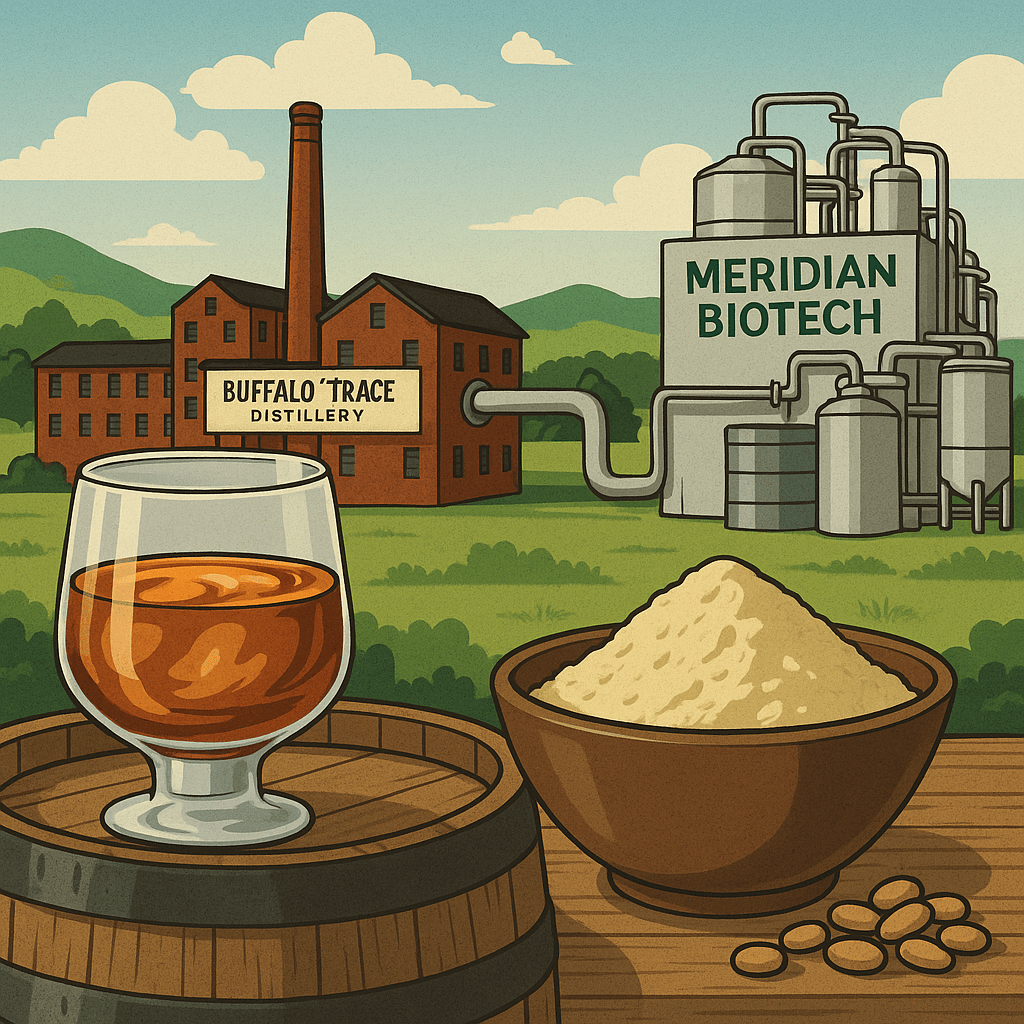
In the land of bourbon, where age-old spirits flow and tradition runs deep, a surprising new kind of transformation is underway … one that doesn’t involve oak barrels or copper stills. Instead, it’s happening at the molecular level, thanks to a biotech innovation that’s turning whiskey waste into something remarkably useful: protein.
Franklin County, Kentucky … long synonymous with bourbon heritage … is now also poised to become a hub for sustainable biotechnology. The reason? A new partnership between Meridian Biotech, a Lexington-based industrial biotech firm, and Buffalo Trace Distillery, one of the oldest and most celebrated bourbon makers in America.
From Stillage to Sustainability
At the heart of this venture is stillage … a nutrient-rich mash left over after the distillation process. Normally, stillage is managed in bulk, often sold off for low-value livestock feed or disposed of as waste. But Meridian Biotech is introducing a more sophisticated and sustainable approach.
The company’s new $40 million facility in Frankfort will convert stillage into multifunctional alternative proteins … high-quality ingredients that can be used in aquaculture feed, pet foods, and even as organic fertilizer. The stillage will be piped directly from Buffalo Trace’s distillery to the new site, keeping transportation emissions minimal and streamlining the entire process.
This is no ordinary protein powder. Using advanced fermentation and bioconversion methods, Meridian’s technology breaks down the byproduct and rebuilds it into functional proteins tailored for specific industries. That means a bourbon byproduct once treated as a disposal issue is now a key player in sectors ranging from fish farming to soil health.
Innovation Meets Impact
Environmental concerns around food production, especially the impact of livestock agriculture and over fishing, have fueled a growing demand for sustainable protein alternatives. Technologies like Meridian’s offer a compelling solution, one that recycles industrial waste into a valuable resource while reducing dependency on traditional protein sources like soy and fish meal.
What’s more, the system is closed-loop and largely local. The byproduct is created, processed, and converted all within the same community. This not only supports regional food resilience but also dramatically cuts down on environmental overhead. It’s circular economy thinking, distilled straight from a barrel.
Beyond Bourbon: Economic Benefits
While the science is impressive, the local benefits are just as significant. The project will create up to 35 high-paying, tech-forward jobs in Franklin County, bringing a fresh wave of innovation to an area better known for aging barrels than biotech labs. It also marks the first time a biotech firm has set up shop in the county … a strong signal that Kentucky’s bourbon belt is becoming fertile ground for new industries.
Local officials are embracing the change, citing the partnership as a model of economic development that honors tradition while embracing transformation. As Kentucky Governor Andy Beshear noted, the project strengthens the state’s future while cementing its role as a leader in both bourbon and biotechnology.
A New Frontier for Distilling
The bourbon industry has long leaned on innovation, from refining fermentation techniques to perfecting aging processes. But this initiative may represent one of its most meaningful evolutions yet. Instead of focusing solely on what comes out of the barrel, it’s about what’s left behind … and how that can be reimagined.
Buffalo Trace’s Master Distiller, Harlen Wheatley, sees this as a natural extension of the distilling craft. “We’ve always respected the full journey from grain to glass,” he said. “Working with Meridian allows us to take our processes even further by transforming stillage into something with extended value and purpose.”
What It Means for the Rest of Us
Alternative proteins might not be on your dinner plate just yet, but they’re quietly reshaping the global food economy … from the salmon farms of Norway to the kibble in your dog’s bowl. And now, thanks to a bourbon-soaked byproduct and a bold biotech vision, Frankfort, Kentucky is playing a central role in that transformation.
The construction of Meridian’s facility is expected to begin later this year, marking a big step not just for one company or one distillery, but for the entire conversation around sustainability, food security, and regional innovation.
So next time you sip a glass of Buffalo Trace, take a moment to appreciate what’s left behind. Because in Frankfort, even the leftovers are getting a second life … and helping feed the future.
To follow the evolution of this project and other innovative food and drink stories from Kentucky and beyond, stay tuned to Sips & Sites & Bites.
 Sips & Sites & Bites
Leave a comment