
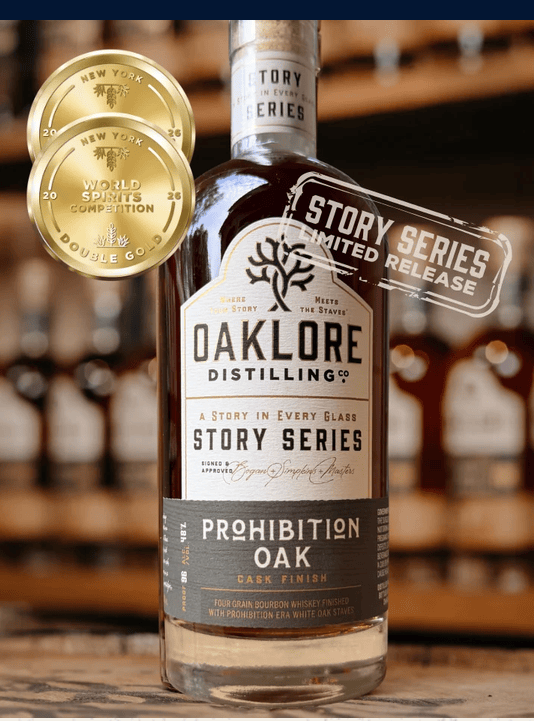
The latest release in Oaklore’s Story Series gets a little help from oak that’s been around since the days of bathtub gin and speakeasies.
Whiskey and wood have a pretty important relationship. The barrel helps turn clear spirits into the amber stuff we love, adding color, flavor and character along the way. But what if some of the wood in your whiskey has been hanging around since the days of Prohibition?
That’s the intriguing idea behind the new Oaklore Story Series Prohibition Oak Cask Finished Four Grain Bourbon Whiskey. And no, you don’t have to sneak it past a federal agent or know the password to a speakeasy to get your hands on a bottle.
Charlotte, North Carolina-based Oaklore Distilling Co. is bringing the whiskey to market in October, and the unusual finishing process gives this release a story that goes well beyond another bourbon hitting the shelf.
Oak From Another Era
Here’s the interesting part. Oaklore didn’t simply age its bourbon in a barrel and slap a Prohibition-inspired label on it. The distillery used toasted oak staves made from wood harvested and dry-aged since the Prohibition era, giving the whiskey a finishing touch connected to a period that helped shape America’s complicated relationship with spirits.
Think about that for a moment. The wood used to help finish this whiskey was around during the years when making, selling and transporting alcoholic beverages were illegal under federal law. While the country was busy with bootleggers, hidden bars and questionable bathtub gin, this oak was beginning a very long wait for its eventual role in a modern bourbon.
The wood isn’t a barrel that has held whiskey since the 1920s, mind you. Oaklore’s process uses toasted staves from that era’s oak, bringing historic wood into the final stages of maturation. It’s a subtle but important distinction, and a pretty creative way to connect the past with what’s happening in whiskey today.
The bourbon starts with Oaklore’s Four Grain Bourbon, aged for more than four years in new American white oak barrels. It then spends another two-plus years double-oaked in a second set of new American white oak barrels. Finally, the whiskey gets six to 12 months of finishing time with the Prohibition-era oak staves.
That’s a fair amount of patience before the cork ever gets pulled.
As Oaklore co-founder Thomas Bogan explains, the release is about patience, history and the influence wood can have on finished whiskey. We tend to spend plenty of time talking about mash bills, proof and age statements, so it’s refreshing to see a distillery explore what happens when the finishing wood itself has a story to tell.
So, What’s in the Glass?
Oaklore describes the finished bourbon as a deeply layered whiskey, with an aroma of Bit-O-Honey candy and fresh leather. On the palate, look for brandied oak and spiced marmalade, followed by a finish featuring sweet walnut bitters.
That sounds like an interesting combination. The honey-candy note suggests a touch of nostalgic sweetness, while fresh leather brings a more rugged character. Brandied oak and spiced marmalade hint at a bourbon that moves beyond the usual caramel-and-vanilla routine, with a finish that should appeal to drinkers who appreciate a little bitterness alongside their sweetness.
Bottled at 96 proof, or 48% ABV, the whiskey has enough strength to carry those flavors without going overboard on alcohol. It’s also non-chill filtered, a choice that leaves more of the whiskey’s natural oils and texture intact.
This sounds like one to try neat first. Give it a little time in the glass, see how the aromas develop and pay attention to the way the oak shows up across the sip. With all that double-oaking and the final stave finish, there’s plenty of reason to explore it slowly before deciding whether a splash of water might reveal something new.
And while an Old Fashioned might be tempting, I’d save the mixing for another bottle. When a distillery goes to this much trouble with its finishing process, it’s worth giving the whiskey a chance to tell its own story.
A Story Worth $70
The new release has already picked up a Double Gold award at the 2026 New York World Spirits Competition, giving Oaklore another accolade for its limited Story Series collection. Of course, medals only tell part of the story. The real test comes when the bottle is open and the whiskey is in your glass.
At a suggested retail price of $69.95 for a 750 mL bottle, Prohibition Oak sits in the premium bourbon category. Availability will be limited in North Carolina and South Carolina, with national shipping offered through Oaklore’s online store beginning in October. The distillery is currently taking preorders, with shipments planned on a first-come, first-served basis.
For whiskey fans who enjoy releases built around distinctive finishing techniques, the appeal here is obvious. Oaklore has taken a four-grain bourbon, given it an extended double-oak treatment and added a finishing element that reaches back to one of the most fascinating chapters in American drinking history.
The best part is that the history isn’t just printed on the label. It’s connected to the actual wood used in the finishing process.
We may never know what those oak staves witnessed back in the days of speakeasies and bootleggers. But more than a century later, they’ve found a pretty good second act.
And if they can help make a memorable bourbon along the way, that’s a story worth raising a glass to.


Leave a Reply