

A new survey finds that Americans are curious about mezcal, but when it comes to knowing what’s in the bottle, there’s still plenty of room for improvement.
Americans seem to like the idea of mezcal. It’s smoky, it’s trendy, it looks right at home on a cocktail menu, and it has that little air of mystery that makes ordering something new at a bar feel like an adventure.
There’s just one small problem. We might not know as much about it as we think.
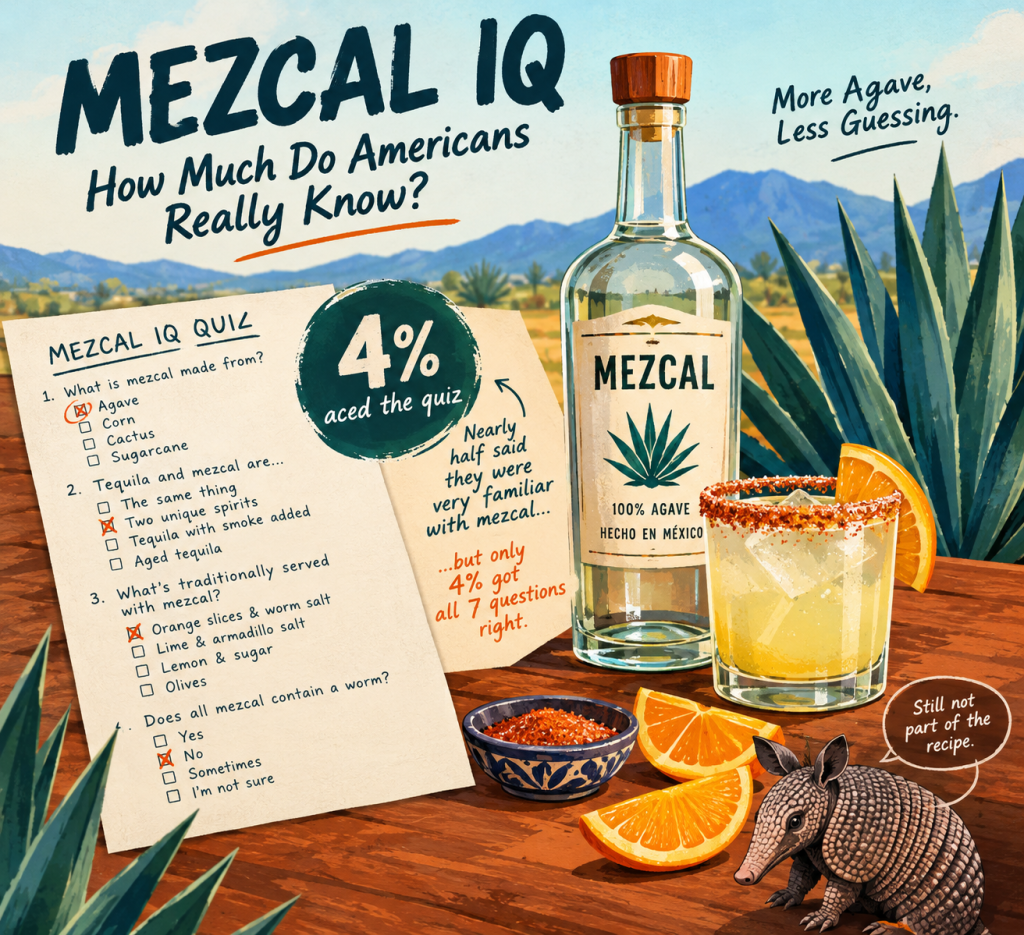
Ahead of National Mezcal Day on October 21, 400 Conejos Mezcal put 1,000 American adults who had consumed alcohol in the past year through a seven-question mezcal knowledge quiz. The results were a little humbling for a country that has apparently decided mezcal is the next big thing.
Nearly half of those surveyed, 49.8%, described themselves as very or extremely knowledgeable about mezcal. But only 4.4% answered all seven questions correctly.
That’s right. Fewer than five out of every 100 people aced the test. Another 64% failed to get even half the questions right.
Welcome to Mezcal 101. Please leave your assumptions at the door.
First Things First, What’s Mezcal Made From?
You’d think this would be an easy one. Mezcal is made from agave, the same broad plant family that gives us tequila.
Yet only 48.5% of respondents identified agave as mezcal’s primary ingredient. Nearly 20% weren’t sure, while others went with corn, desert cactus or sugarcane.
Corn? Understandable if you’ve spent a lifetime around bourbon. Cactus? Well, agave does look a little like something that belongs in the desert, so we’ll give that one a small courtesy nod.
But agave is the answer.
The confusion gets more interesting when tequila enters the conversation. Just 36.9% correctly identified tequila and mezcal as distinct agave spirits with their own rules and roots. Others thought mezcal was aged tequila, tequila with smoke flavor added, or a spirit made from cactus.
Here’s the simple version. Tequila must be made from blue Weber agave, while mezcal can be made from a wider variety of agave species, subject to the applicable production rules. Both come from Mexico, but they’re not interchangeable names for the same drink.
Think of them as relatives, not twins.
Does All Mezcal Taste Like a Campfire?
This is probably the biggest misconception about mezcal, at least for anyone who has browsed a cocktail menu and wondered whether their drink might taste like a burnt log.
About half of respondents, 51.9%, correctly understood that many mezcals have smoky notes, but not all mezcal tastes smoky. Another 16.9% believed every mezcal tastes smoky, while 22.2% weren’t sure.
Some of that smoke comes from traditional production methods, which can involve cooking agave hearts in underground pits. But mezcal isn’t a one-note spirit. Depending on the agave variety, production method and producer, the flavor can range from earthy and herbal to fruity, floral, mineral or smoky.
In other words, if you’ve tried one mezcal and decided it wasn’t for you, you haven’t necessarily met the whole category.
And if you’ve avoided mezcal because you’re worried your Margarita will taste like somebody poured an ashtray into it, you might be missing out.
The Worm and the Armadillo Incident
Every spirit has its myths, but mezcal seems to have collected a few particularly memorable ones.
Only 25.2% of respondents knew that mezcal is traditionally served alongside orange slices and worm salt. That leaves plenty of room for improvement, but the real entertainment came from the alternative answers.
A whopping 32.7% selected “lime and armadillo salt.”
We’d like to know who introduced that particular garnish to the conversation. Somewhere, an armadillo is probably wondering what it did to deserve this.
The worm question didn’t fare much better. Only 45.1% knew that some mezcal bottles contain a worm, but it’s not a requirement. Another 13% thought all mezcal contains a worm, while 15.4% believed it can’t legally contain one.
For the record, the worm isn’t a defining feature of mezcal. It’s associated with some bottles, but plenty of excellent mezcal comes without one. You don’t need a floating creature in your glass to make the experience authentic.
And while orange slices and worm salt are a familiar traditional accompaniment, there’s no mezcal police department waiting to issue a citation if you prefer your pour another way.
So, How Are Americans Actually Drinking Mezcal?
The good news is that people aren’t just talking about mezcal. They’re drinking it, experimenting with it and finding their own ways to enjoy it.
Among current mezcal drinkers in the survey, 46.6% said they enjoy it as a shot, while 44.2% selected cocktails and another 44.2% said they like it over ice. Sipping it neat at room temperature also has a following, at 41.8%.
Those answers allowed multiple selections, so apparently today’s mezcal drinker isn’t particularly interested in choosing just one camp.
When asked which mezcal cocktails they’d consider trying, the Margarita came out on top. Forty-four percent of respondents selected a Mezcal Margarita, well ahead of options such as a Mezcal Old Fashioned at 30.2% and a Mezcal Mule at 28.3%.
That makes sense. A Margarita is a familiar starting point, and swapping in mezcal can add a savory, earthy or smoky dimension without requiring anyone to learn an entirely new cocktail vocabulary.
For those who want to branch out, mezcal also works in spirit-forward drinks such as an Old Fashioned or a Negroni, where its character can stand up to bitters and other strong flavors.
The survey suggests there’s plenty of room for bartenders to introduce people to the spirit one drink at a time.
There’s Curiosity, Even if There’s Not Much Knowledge
Here’s where the numbers get encouraging.
Among the 500 respondents who weren’t current mezcal drinkers, 38.4% said they knew about the spirit but had never tried it. Another 34.4% had tried it more than a year ago, while 27.2% were completely unfamiliar with it.
Meanwhile, 70.2% of the full survey sample said they were somewhat or extremely likely to drink mezcal in the next three months.
That sounds like an opportunity for mezcal producers and bartenders, although enthusiasm doesn’t always translate into a bottle purchase.
The biggest barriers weren’t especially complicated. Some people preferred tequila, others didn’t know enough about mezcal, and many said they had trouble finding it or didn’t know which brands to choose. Concerns about price and the expectation that mezcal would be too smoky also showed up.
In other words, some consumers may need less marketing mystique and more straightforward explanation.
Tell people what they’re drinking. Explain why one mezcal tastes different from another. Offer a small pour before committing to a bottle. And maybe don’t lead with the armadillo salt.
Interestingly, the survey also found that current drinkers most often discovered mezcal through friends or family, followed by a bartender or restaurant menu and travel experiences. That suggests personal recommendations and a good first pour may do more to build interest than a complicated backstory.
Time for a Little Mezcal Homework
The survey was commissioned by 400 Conejos and conducted by Proximo Spirits with research partner Suzy in September. It included 1,000 U.S. adults ages 25 to 49 who had consumed alcohol in the previous 12 months, split evenly between current mezcal drinkers and non-drinkers.
It’s a snapshot of a particular group, not a complete measure of every American’s mezcal knowledge. Still, the results make a good case that familiarity and understanding aren’t quite the same thing.
The good news is that nobody needs to become a certified agave expert to enjoy a good pour. Start with a cocktail if that’s your comfort zone, ask a bartender for something approachable, or try a small neat pour to get a better sense of the spirit itself.
Just remember three things. Mezcal is made from agave. Not every mezcal is smoky. And unless somebody is trying to pull your leg, you probably won’t need armadillo salt.
National Mezcal Day arrives October 21. Consider it a good excuse to raise a glass of 400 Conejos, learn something new and finally get that quiz score above 50%.


Leave a Reply