

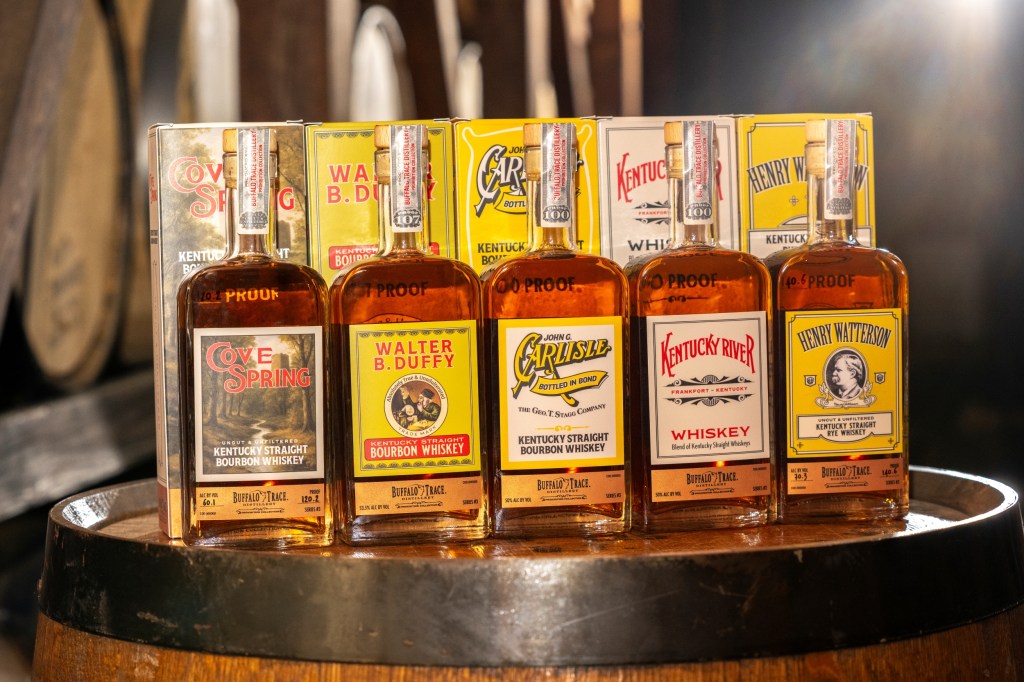
Whiskey collectors have no shortage of limited releases to chase these days, but every once in a while one comes along that’s just as interesting for the story behind the bottle as what’s actually inside it.
That’s the case with Buffalo Trace Distillery’s third annual Prohibition Collection, a five-bottle set that takes drinkers on a tour through one of the strangest chapters in American whiskey history.
It still seems almost impossible to imagine today, but during Prohibition, when nearly every distillery in America went dark, a select few were allowed to keep producing whiskey … as medicine. If your doctor wrote you a prescription, you could legally pick up a bottle from the pharmacy. It might be the only time in history someone left the doctor’s office feeling genuinely excited about their treatment plan.
Back then, Buffalo Trace was known as George T. Stagg Distillery, one of just six distilleries licensed by the federal government to bottle medicinal whiskey between 1920 and 1933. Instead of simply recreating old recipes, the new Prohibition Collection digs through the distillery’s archives to resurrect long-forgotten whiskey brands that once lined pharmacy shelves nearly a century ago.
This year’s collection includes five names that most modern whiskey fans have probably never heard of … Henry Watterson, Kentucky River, John G. Carlisle, Walter B. Duffy and Cove Spring. Each has its own connection to the distillery’s history, and each whiskey has been crafted to reflect the personality behind the original label.
The boldest bottle of the bunch may be Henry Watterson, an uncut and unfiltered Kentucky straight rye bottled at a hefty 140.6 proof. Watterson was a Pulitzer Prize-winning journalist and outspoken opponent of Prohibition, making him an appropriate namesake for a whiskey that certainly doesn’t hold anything back.
Kentucky River takes a gentler approach, blending Kentucky straight whiskeys into a smooth 100-proof pour that tips its cap to the river that helped fuel the distillery’s growth by transporting barrels, grain and supplies long before interstate highways existed.
History buffs will probably appreciate John G. Carlisle as much as bourbon fans. Carlisle helped champion the Bottled-in-Bond Act of 1897, one of the most important quality standards ever established for American whiskey. His namesake bourbon sticks to that bottled-in-bond proof of 100 while offering a classic Kentucky profile filled with caramel, orchard fruit and baking spice.
Walter B. Duffy honors the businessman who placed Albert B. Blanton in charge of the distillery during Prohibition, a decision that would shape Buffalo Trace for generations. Fittingly, this release blends 10- and 14-year-old bourbons into a rich, mature whiskey bottled at 107 proof.
Rounding out the collection is Cove Spring, a wheated bourbon bottled uncut at 120.2 proof. Named after the spring that supplied water to the early distillery, it serves as a reminder that great whiskey has always started with great water.
Even the presentation leans heavily into the history lesson. The five 375 ml bottles arrive in a wooden display case featuring archival imagery, while the cartons recreate the old prescription cut-outs physicians once used to authorize medicinal whiskey purchases. It’s the kind of packaging that collectors will probably admire almost as much as the whiskey itself.
Of course, collecting this bit of history won’t come cheaply. The Prohibition Collection carries a suggested retail price of $999.99 for the five-bottle set, and quantities will once again be extremely limited.
Still, whether you manage to snag one or simply enjoy reading about the fascinating era it represents, Buffalo Trace deserves credit for doing something more than releasing another fancy bottle. This collection reminds us that whiskey history isn’t just about what’s in the barrel … sometimes it’s about the remarkable stories that kept those barrels alive in the first place.



Leave a comment